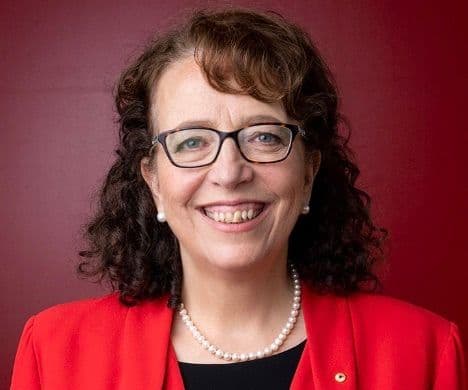
Professor Ingrid Scheffer
Chair of Paediatric Neurology at The University of Melbourne and Senior Principal Research Fellow at the Florey Institute of Neuroscience and Mental Health.
- 1:30pm – 2:15pmDevelopmental and Epileptic Encephalopathies: New Insights and Therapeutic Advances
- 4:15pm – 4:55pmPanel
Professor Ingrid Scheffer is Chair of Paediatric Neurology at The University of Melbourne and Senior Principal Research Fellow at the Florey Institute of Neuroscience and Mental Health.
Watch the talk
Developmental and Epileptic Encephalopathies: New Insights and Therapeutic Advances
Prof Ingrid Scheffer
In this insightful presentation, Prof. Ingrid Scheffer explores the complexities of genetic developmental and epileptic encephalopathies (DEEs), shedding light on both the challenges and advancements in the field. This talk addresses the importance of early diagnosis, the impact of genetic mutations on epilepsy, and the latest developments in precision medicine, including gene therapies.
Key topics covered:
- Understanding DEEs and their genetic causes
- The prevalence of DEEs and their impact on patients and families
- Current and emerging treatments, from repurposed drugs to precision medicine
- The role of movement disorders in DEEs and the importance of differentiating them from seizures
- Ongoing research in gene therapy and antisense oligonucleotides
Prof. Scheffer emphasizes the importance of patient and family involvement in advancing research and improving outcomes. Join us for this in-depth discussion on the future of epilepsy care.
Read the transcript
Thanks very much and it’s so good to have a GETA conference again after a little hiatus. And I missed the last one in Sydney so it’s lovely to be with you all. AndI want to spend some time talking about some new data, but also spend a good half of my talk about therapeutic advances and how we need to think about this more broadly in genetic DEEs. But I wanted to start by thanking you because there’s no way that we could do any of our research without you on developmental and epileptic encephalopathies, these very difficult diseases without family involvement. And I wanted to thank you who have participated in our research for many years. Both here in Melbourne and I’m sure some people online and around the world. And also very much for allowing me to share pictures of your beautiful children. Some of them are having seizures, which is always hard to watch but I do think a picture says a thousand words and Jackie was certainly very pleased on Thursday night when I shared her beautiful images and I’m not sure if she seems like she’s gone because it’s got much quieter in here. And I just want to really acknowledge that we can only take the field forward with your help. I know how hard and stressful life is, as a parent of a child, with a developmental and epileptic encephalopathy, and to do research is a whole extra burden, but we really appreciate it. And I’m speaking for Katherine here as well and other clinical researchers, as well as the scientists. Thank you, Steve. And I finally wanted to thank our inspirational founders. And I’m incredibly fond of all three of these leading families that have led the way. There have been, I don’t know how they found the bandwidth to do this, in addition to caring for their lovely children. And I think it’s people like this that change the world and I’d like us all to stop and clap the founding parents.
Okay, so for those who are new to the field, I’m going to define a developmental epileptic encephalopathy. I know many of you have heard me talk about the past and I have I’ve changed my slides a bit to keep you all awake but also to tell you that many doctors still do not understand these diseases and Katherine and I spend, and Phil, spend much of our lives teaching people what we really mean.
I’m going to tell you about some fairly new data looking at how common they are, how many genes that they can cause, a DEE, which you’ll find we all like that phrase because it’s much quicker. I presented our study on movement disorders in patients with DEEs at Kris invitation last year online. But Kris said it would be good to revisit that a little bit. So I’m doing that in a sort of more clinical and shorter form. And then the second half of the talk is going to look at advances in treatment, old drugs, new tricks, what we mean by trial design, precision medicines, and particularly with an eye to gene therapies and natural history studies. So let’s start at the beginning.
And what do we mean by this? Long term developmental and epileptic encephalopathy. It brings together three components. One is cause, and of course the most frequent cause of these diseases is a genetic cause. But we know you can have other causes, you can have a damaged brain that can lead to this sort of structural abnormality.
We know that for these diseases, you must have epileptic activity. If you don’t have epileptic activity, you don’t have a developmental and epileptic encephalopathy. And you have developmental impairment. So just to focus on the term epileptic encephalopathy, The archetypal one is called Infantile Epileptic Spasm Syndrome. And here you see an identical twin, a beautiful little girl. And you can see she’s having a spasm there. And she has these series of spasms that might go on for 3 minutes, they might go on for 20 minutes, there’s another one. And there are many genes that lead to this, but particularly CDKL5 and STXBP1.
And the idea here is that you have this very active epileptic activity. And this has a classical EEG called hypsarrhythmia where your EEG’s gone mad, if you will. And that very active EEG actually is negative for development. So the child loses their abilities. They might stop looking or smiling or interacting.
Now, we changed the term, we expanded it to Developmental and Epileptic Encephalopathy because we realized that many of these genes caused an adverse impact on development in its own right. So here you see the sodium channel, SCN the alpha 1, the alpha 2, The alpha subunit of the sodium channel comes in many flavors, the alpha subunit, and you can see it here in the cell membrane, and it’s through which the sodium ions pass.
And we know that this causes, that’s the cause, SCN1A, it causes lots of epileptic activity, which in turn causes epilepsy. Developmental slowing or actually you go backwards, you lose your abilities. But we realised with time that these genetic abnormalities also cause other problems. So in Dravet Syndrome, here you’ll see two patients with Dravet Syndrome and you can see how this gait deterioration is really severe in this 28 year old and he can barely keep walking.
That’s due to SCN1A, I don’t think it’s due to the epileptic encephalopathy. So we’re bringing together these two components. And I don’t need to tell the parents in the room about the fact that these are multi morbid diseases, many different problems associated with them. And I think Katherine’s going to touch on that later.
But most of the patients will have many other things. systems of their body impacted, as you can see here. Gait, guts, sleep is a terrible problem as families know. Behaviour, also a terrible problem. Development, seizures and movement disorders. Now, behaviour is not always a terrible problem, but when it is in the 60 percent where behaviour is a problem, it’s life threatening for everyone.
In the 40 percent where behaviour is not a problem, they look and go, really? How’s the problem? There is hope that your child will not have behavioural problems. But when they are, they’re often the thing that becomes the biggest problem. And we’ve got a very exciting new study that’s going to hopefully translate to a change in those outcomes
How common are they? we studied the Wellington region of New Zealand, where we could capture all EEGs. And we showed that up to the age of 16 years, no one has done this before. So it’s very important data. There is a 1 in 591 children will have a DEE. And why does that matter? It really matters because rare diseases as a group are not rare. Your gene might be rare, as Kate said before. She’s got a really Difficult to remember gene, but we’ll get there, the name, and I think your gene might be really rare, but as a group, you’re not rare, and that’s why you’re all here today.
And if we can get our governments to understand how important these children are, and how much they need extra help and resources, I always think you should take the child to the NDIS office and say, Meet Joy, then that would change their view of the world. And this also is very important for investment in new therapies, as we heard from Steve and we’ll hear from Sal a bit later on.
So we’ve talked a lot about these developmental and epileptic encephalopathies, but how many genes are there? We published a paper last year and we found that of the robust monogenic epilepsy genes, that means you have a mutation of that gene and you have the disease, like SCN1A and Dravet syndrome, for example, or KCNQ2, then how many genes are there like that?
There are 926 a year ago, and 825 of those result in DEEs. And one of the mums before said that they don’t know the gene yet. I think it’s just a matter of time. At the moment we’re solving 50%. I have hope that the other 50 percent will be solved. And if you’re not solved and you want to be in our studies, please consider that.
So we just looked, and we’re now up to more than 900 DEE genes. So in a year and it’s going up like that. So the big issue is if you don’t know the gene causing your child’s DEE, go back to your neurologist, go back to your geneticist and they need to re analyse the data every two or three years at the moment because genes are changing all the time. The genes aren’t changing, our knowledge of them is changing.
All right, so let’s then move on to this question of movement disorders. And this was a study really led by a very talented medical student, now junior doctor, called Sterre van der Veen from the Netherlands. And she is going to be an adult neurologist with an interest in movement disorders and she came to our group for six months and picked up the project which was initially started by Gabrielle Tse. And it came about because we realised that the movement disorders in our patients were much more frequent than we had realised. And why does it matter? It matters because if the movements are epileptic seizures, then we would treat them differently to, if they were non-epileptic movements, and if they’re epileptic, you’d obviously use anti-seizure medicines. If they’re movement disorders, you might use medications for movement disorders. But often we don’t treat them. And there are other strategies such as deep brain stimulation that one might consider using in a very severe movement disorder. This lovely brother and sister I look after, she’s four here and he’s two. And you can see he has this very severe hypokinetic movement disorder. She had it too, but a little bit more mild. But to the point the family can barely go out because he’s at such risk of injury. And both of these children don’t walk or talk. They had epileptic spasms, but their epilepsy really is quietened down. But the movement disorder is terrible. And for other genes, we have similar questions. Is it a movement disorder or is it a seizure? Now, I think this one is clearly a movement disorder for a neurologist, but some of the others can be difficult to differentiate.
We hypothesized in this study that specific genetic DEEs were associated with specific movement disorders. And that pattern of the movement disorder may be influenced by the biology of that gene, if that makes sense. So this was, if you like, a preliminary study. Putting out there, this is how we need to think about this. 77 patients, a median age of 9 years at study, but you can see as old as 38. And over half were female, 3 had very sadly passed away at these ages. The median age of the onset of the movement disorder, as best as we could tell, was about 18 months, but it could be as late as 35 years. These children had all had seizures long before the movement disorder, with a median onset at four months. And they presented with epileptic spasms. I just showed you some spasms some myoclonic seizures or tonic clonic seizures. And when I say presented, I mean their first seizure. They had intellectual disability in all, 72 percent were severe and 15 percent profound. So this is a very severe group of patients and 70 percent could not walk. And so here you see the types of movement disorders. Stereotopies becoming, being the most frequent. I’ll show you that in a moment. Dystonia, then chorea, and then some other types of movement disorders. Ataxia means unsteadiness, and that was more likely if the child could walk, or if they had milder intellectual impairment. Dystonia, which is funny posturing, was more likely if you couldn’t walk, or if you had moderate to profound intellectual disability.
So let’s just start with chorea. Now these are three unrelated boys. They have the same SCN1A mutation and they have this early infantile DEE that we reported back in 2017. It’s now exploded, this group. There are many patients with this and they’re due to gain of sodium channel function. So same gene as Dravet’s loss of function. This is gain of function, and these children don’t walk or talk. And they all have this chorea, and they also have this mouthing chorea as well. If you watch, they’ve all got this similar mouthing problem. And there are now a number of different mutations that cause this presentation. In fact, some even worse in newborn, or they die in utero. So that’s chorea, and here you see some other children. This is a brother and sister with DNM1. And it’s the same brother and sister I showed you before and a bit older. And you can see the sister has got quite a much milder picture, but the brother is now longer and taller, but his movement disorder is really no better. Now, in our whole cohort, there were 18 patients with this chorea.
Now, Dystonia was seen in 34 of the patients and this is a lovely young man now about 22 or so but he has dystonia with this funny posturing and here you see him also with the stonic movements of his legs so that’s examples of his hands and his legs with this dystonia and you can see it doesn’t look very comfortable. And this is when I was at the KCNQ2 conference in 2018 in the U. S. And the same one I think that Phil was talking about with the dogs. And this is one of the little boys there that had stereotypies. And then I saw another little boy with stereotypies. And then you see Jackie here with a leaning back. Which is in the same sort of group of movement disorders. And at one stage she was almost falling over with that. So they’re stereotypies.
Now, what about movement disorders? About half of the children and adults had a single movement disorder, but interestingly, almost half had more than one. And the most common was this group of chorea and dystonia, which you see here. And then there were other combinations that you could see that went together. And 10 of the patients had paroxysmal, which is just a medical word for intermission. So episodes of that type of dystonia, which was the case for 8 patients or unsteadiness or tremor.
So you’re asking, was my gene in this study? And the answer is there were many genes in these 77 patients. And we only chose patients who had movement disorders. So this is skewed totally to describing the movement disorders. And you can see there were seven with STXBP1 and seven with CDKL5, but there were 29 genes where we only had one or two patients. So you can’t make good conclusions, strong conclusions, but it just gives you the hint of which genes may be associated with movement disorders and what types of movement disorders.
So we looked at the biology, and I had hoped we’d come up with a really clean picture, but medicine never does that quite. And so what we found were there were some groups we could see that tended to have a specific picture. So sodium channelopathies and potassium channelopathies were most likely to have dystonia, as was synaptic vesicle trafficking. So STXBP1 is one of the more common genes there, and dynamin 1. And then if you looked at transcriptional defects, so that’s how the genes are transcribed into protein There are lots of regulators of transcription and these were most likely to be associated with the stereotopies. They’re in the purple and then we saw mixed pictures with the other types of genes involved
So what’s the take home for you from this study? Is that Movement disorders are under recognized in DEEs, and when you give a talk about something like this, you can see all these neurologists go, oh yes, and they go back to see their patients and they see the movement disorders, because before we were so busily focused on trying to help the seizures, we didn’t see the movement disorders.
But it’s important to differentiate movement disorders and the best thing you can do is use your phone and get multiple examples of these abnormal movements. Because when I look at a video, I don’t want to see one, I want to see three ideally at least. I want to see what the child’s doing, good lighting, no covers on, as in no bed linen. And I want to be able to see what the child’s doing, what’s triggering the episode. And. I want to see how similar the episode is from one to the next. And sometimes I can’t tell and we need to do video EEG monitoring. So one of my young adults, she’s probably about 25, I saw her just recently about four years ago, her mother said, Oh, she’s, she has this very severe chorea. We have never found her gene, but we keep looking and she’s nonverbal and she doesn’t walk. And mum was saying she had these really severe, where her movement disorder went mad and we brought her into hospital, did video EEG monitoring and they were frontal lobe seizures. There was no way I could tell that by looking at her, but the EEG was very clear. And so that was good because it gave me something that I could then try and treat to try and improve. So it’s much better now. So we need larger cohorts of patients with each genetic DEE to understand who gets the movement disorder, how bad is it, what happens with age. And we hopefully will get these wonderful new treatments that are tailored to a genetic aetiology, such as gene therapy. And those treatments will treat all of these aspects, including the movement disorder.
Okay, so let’s move on then to therapeutic advances, and I wanted to encapsulate this into three sort of subgroups. Available drugs, there may already be drugs out there that we are using that will target your genetic mechanism, and that means there might be something that we can pull out of the box that will be very appropriate for your drug, for your child. Then we also need to look at repurposing drugs, old drugs. And then finally, where all the excitement is, precision therapies and natural history studies. With precision medicine approaches, I think we start from the day we get a diagnosis. We don’t need to wait for something to come along. We need to think about it on that day. What does that gene tell me that means I could then use this drug? And a particular genetic diagnosis may tell you which anti seizure drug to use, and that in effect is a precision medicine. Everyone thinks it’s magical. It’s not. It’s got a rationale.
Here’s a real seizure diary that one of my colleagues very kindly lets me use from a mum. So maybe the mum’s sitting here. So if you are, thank you. And you can see here, this child started having generalized tonic clonic seizures at just after five months of age. Their neurologist started This baby on Keppra (levotiracetam) and you can see here by here the neurologist decided it’s not really doing much good for this baby. I’m going to start oxcarbazepine (Trileptil). What did that do? Made it much worse. Anyone like to guess the disease? Dravet. Exactly.really we should be thinking about it here and not using Keppra and not using oxcarbazepine, but using Dravet drugs. So that’s just our day to day drugs, there’s nothing special. But this is really important across three of the different sodium channel genes that all cause DEEs. It’s 1A, which is Dravet and this very early infantile form I’ve shown you, but also a mild disorder that’s not a DEE called genetic epilepsy with febrile seizures plus SCN2A, that’s the alpha 2 subunit. It looks like this too, but it’s a different iron channel subunit and 8A, similar again. So they’ve all got this mild version that if you or I had it, we could still be sitting here, no epilepsy, normal intellect, grown out of it, all fine. So it’s really important if you get a gene change to understand where this patient sits. Do they sit at this end, which is, good news by comparison, or here, or are they here? And then, You have to drill down and understand the functional effect. And we had a bit of a discussion. We heard a lot about it at the KCNQ2 dinner on Thursday night. But obviously if you have loss of function, you treat it very differently to gain of function. And if you give a gain of function drug to a loss of function where you’re trying to dampen down that gain of function, you give it to a loss of function child, it’s a disaster. You could really hurt that child. So you really need to understand which it is, and you won’t know that. I might not know that, but my physiologist, like the wonderful Steve Petrou that you heard from, and his whole team, they’re the ones that will determine that. And with a lot of the gene therapy studies now, people are being incredibly careful to make sure they know if it’s a loss or gain of function abnormality. And you’ve got to know that because you want to do no harm. So if you look here in the little gray arrows, I’ve shown these guys with gain of function, all of those patients will benefit from a sodium channel blocking anti seizure drug. And by that we mean Tegretol, which is carbamazepine, oxycarbazepine is Trileptal. And then there are a host of other drugs, that have a bit of a sodium channel blocking effect, but some of them are good for Dravet syndrome. For example, I think topiramate is very good for Dravet syndrome, and it has a bit of a sodium channel blocking action. Lamotrigine is up for discussion. So I think one has to really understand what’s going on. And that’s the first precision medicine.
So now let’s talk about repurposing drugs that are not precision medicine. So you hear a lot of hype about fenfluramine, great drug for Dravet syndrome, but not a precision medicine. And here I just wanted to give you a few slides on what a randomized double blind placebo controlled trial is, or an RCT as we refer to it, because you need to understand why we bother to do that. And the answer is to get scientific evidence. What sets us apart from a naturopath or a homeopath is the scientific evidence. And that is what we spend many years training in to understand that. And this is where you give a patient a placebo or the drug and you say, does it make a difference? And why is that? Because of the placebo effect. And the placebo effect relates to all of us as humans, we all have a risk of a placebo effect. Who wants to guess what’s the percentage likelihood that if I give you a sugar tablet and I’m the doctor and I say it works, what’s the likelihood it will work? 33 percent of people will get better because we say this will make you better. And that’s why, we don’t cure diseases. What do alternative medicines use? They use that 33%. And I know that people don’t want to hear it, but it’s the reality. And that’s why we need a randomized control trial where you have populations of patients, they’re on their usual antiseizure drugs. You add the new drug or the placebo, and then you can figure out how that works. And in fact, my, our drug trials team are here as well, the nurses that many of you know through our trials group, and that’s exactly what they’re doing, these trials. And we’re doing them to get drugs to you because we want to see if they work and help you to access something. How does this work? We get information about the patients, we check they’re eligible for a trial, gets it put into a computer database, the computer gives every participant a code, and then the codes are randomly assigned by the computer. We have no say in this, at all. And they go, half go to this patient, this patient gets drugged, this patient gets placebo. And do we know? Absolutely not. We don’t know. Our nurses don’t know and our pharmacists don’t know. It’s done at the back end. So it’s really blinded.
And the reason you might say why would I give my child, who’s having lots of seizures, nothing but a sugar tablet for three months? Why would I do that? It’s a good question. Why would you do it? You’d do it because some of these drugs you can’t get access to for years. And fenfuramine is a perfect example of that. I have children and adults with Dravet syndrome and adults with Lennox Gastaut syndrome who got fenfuramine eight years ago. And we still haven’t got it on our market yet. We’ve now managed the company UCB and I think Colin was here before, don’t know where he is now. Very kindly have allowed some patients to go on it. But it still has to get to our health system. It’s probably another year away, hopefully less. And it’s an expensive drug, but it’s a great drug for Dravet Syndrome. So the getting into a trial gives you access. It gives you three months where you might get drug or not. For And you have no say and we have no say, but after that the carrot for you is that your child gets access to a drug that could be their magic bullet. And certainly fenfluramine is for some people, CBD is for some people, CBD is now on our system for specific syndromes. It gives you the opportunity of seeing the medical team frequently. It’s not usually me, but it’s very competent fellows like Annie, who you’ll hear from tomorrow. And the companies typically, we push very hard for them to give drug until the drug is available on the PBS.
Now, they’ll do that if a drug is effective, but Australia is a hard market. The drug companies do not like Australia because our government plays tough with the medicines, how much they’ll pay for medicines. And so fenfuramine actually, when it was owned by another company called Zogenics, they weren’t interested in coming to Australia. And I used to go and pummel on their door and say, look, I’ve been in your trials. We need this in Australia. But thankfully UCV bought Zogenics and that has meant that they’re more interested in being invested in our population, Because they know that Australia rocks. The drug companies often will fly patients from interstate, So just if you’re in another state or you’re online and you’re from somewhere else doesn’t mean you can’t get into the trials. It does, it’s a big hassle to fly from interstate, as interstate families will tell you. And New Zealand, we’ve had quite a few Dravet kids come from New Zealand as well.
With that as background, I’m going to tell you about two, Phenferamine, and then I’m going to tell you about CBD. Phenferamine was initially a hot new diet pill in 1973, and then it emerged that there was cardiac valvular thickening, and they withdrew it. But there’s a king in Belgium, as you probably know, and he had a royal degree that allowed a certain number of patients who’d shown a dramatic effect to continue it for 20 years and they remained seizure free. And in retrospect, they had Dravet syndrome. And this works at the serotonergic receptor, including a number of different subunits. So here are the data, and I’m just going to show you the data quickly, just so you get your eye in. So this is the percentage difference from placebo. So we’re not seeing the placebo rates here, but this is how much it differs. And there’s a definite dose effect. So if you’re on the lower dose You can see There is a 63. 9, almost 64 percent difference from placebo in mean monthly seizures. That is huge. Most trials are about 30%, so that is huge. And even at the lower dose, it’s around that 30%. And then the other number, the metric we use a lot, is the 50 percent responder rate, and it’s 40%, which is still Very good. And then the question of course is seizure freedom. We all want everyone to be seizure freedom with these diseases. It can be really hard to get seizure freedom. And you can see that 7. 5 percent on the high dose was seizure free, but another 17 and a half percent had one seizure. And this is from children that were having one a week or one a month. Or one in two months. So a major change. And these seizures could be life threatening, all of them status, as the Dravet parents will well know. And does it last long term? Here are studies showing that yes, it does last over the longer time, and I’m involved with the ongoing assessment of the data, and it seems to hold its effect, which is great.
So let’s turn to cannabis, and of course cannabis is extremely hot, everyone wants cannabis. And the problem with cannabis is the huge placebo effect. Because your grandmother, your next door neighbour, everyone tells you your child should be on cannabis because it’s magic. But the problem is, we have all formulations apart from cannabis from Epidiolex, are nutraceutical grade, which means you don’t know when you give your child that cannabis whether they’re getting drugged, even if there’s any drug in it. There’s a group from Sydney that analyzed what parents in Australia were giving their children, and quite a few of the compounds had no CBD in it. If you grow it down the backyard, there are many species and there are 400 compounds in the cannabis plant. And some of the families, or not the families really, the people growing it, say there’s this entourage effect, the magic of the other compounds with it, but there’s no evidence for that. And the placebo effect has really clouded the studies. The other thing that really worries me is that in the cannabis plant you also have, the CBD is good for epilepsy, the THC is a psychoactive component, which is why you smoked it when you were a bit younger I suspect. But that component has been proven to be associated with earlier onset of psychosis.
Now, in our DEE, adolescents and adults, how would you know if they’re psychotic? We can sometimes tell they are, but it’s really hard, so it scares me to give their brains, THC, and it’s also expensive. And this is the seminal study in the New England Journal of Medicine that looked at the pharmaceutical grade Epidiolex, remembering everything else is nutraceutical grade. And that means every time you give this dose to your child, you know what they’re getting. And it’s almost all cannabidiol. And I was involved, they I was involved in checking that all the patients actually had Dravet syndrome. And so here you can see the data. I’m just going to do this rapidly, but good news on the CBD, 40 percent or so have a 40 percent reduction in seizures compared to the placebo, and here the total seizures. These are convulsive seizures and total seizures. And just look at this bit, the 50 percent responder rate is 43 percent, but look at the placebo is 27 percent.
Now this is a latest study that we did that was really interesting because they had pushed the 20mg per kg per day but have a look here, the 10mg per kg per day in the dark green is probably better than the 20mg per kg per day. And, this drug costs about $25,000 a year for an adult dose for the PBS, that’s your taxes and my taxes at work. So if we can do it at 10mg per kg per day as well as 20 We should be doing 10, shouldn’t we? And less side effects and just as good efficacy. So these ongoing studies are very important.
Okay, I’ve got to go faster. So let’s talk about precision medicine approaches. And I wanted to spend a little bit of time talking about Tom, who you’ve heard about before from his amazing mum, Kate. And he’s a three year old boy who presented with very severe focal seizures at three years of age on the background of mild speech delay. He had very frequent seizures and he has a recessive disease called CLN2 disease or neuronal steroid lipofuscinosis. And this is what’s missing, this enzyme. And I just wanted to point out that here it’s not a gene therapy. He’s got an enzyme missing in his brain and they’re giving it into his brain, which he gets every two weeks for the rest of his life. And you can see here the natural history study data of these patients. And you can see how they decline and they all died. So this is neurodegenerative, which is another degree again, if you like. And here’s with the replacement enzyme that has to go into his brain. And here you see Tom and this is before he got too severe, before they went to Italy to access the drug. His parents are amazing barristers and they have managed to get access to it for all Australian children. Which is amazing. But you can see it’s expensive. And this happened because of the families. The families lobbied the government. They’re not interested in what doctors say, they’re interested in what you say. But is that all good news? It’s not. Because this is now Tom down the track. And the drug does not get to his eyes. And he now is blind. And you can see his unsteadiness is worse. He’s still with us. He wouldn’t be here without it. so the point here is to tell you that the good stories, they still need to be watched, we need to monitor, we need to see the outcome.
Now I’m going to get faster, I’m afraid, but I just wanted to talk about natural history studies. And we have our own DEER one, and Katherine’s going to talk about it, we’d love to recruit you to it. But both Envision and Encoded that we’re going to hear from Dr. Rico in a moment, and Stoke have had natural history studies. This is the sort of data from Stokes showing the natural history is the seizures don’t get better, the natural history is the development of cognition and behavior don’t get better.
With gene function, we’ve heard all about antisense oligonucleotides, thanks to Steve. And the idea in Dravet syndrome is that you’re going to upregulate the good gene copy. And this is the ASO that Steve described. And you can see here the idea is to upregulate, have more protein of the good copy and forget the bad one. Does it work? You saw a nice picture like this from Steve and here the mice with Dravet syndrome all die and with the ASO they look very good, as good as their control cousins. And this is just showing that SCN1A is in the brain.
So I just wanted to present to you in three slides the result from Stoke and these were hot off the press, they’re only a press release, they’re not a paper. That’s not great science. We want the paper. Phil and I want to read the paper, but this is still the beginning of the answers that we want.
So this is an ASO for Dravet Syndrome, upregulating the good version. And you can see here it’s 70mg. Remember Steve was talking about 1mg. And you can see here that it’s 70mg, the seizures stay way down. And this looks at where the problem with an ASO, that Steve, I don’t know if he said this, is you have to have it three or four monthly for the rest of your life. So that’s a big deal and this refers to the number of the change in baseline from seizures and the outcomes for cognition and behavior. It’s a bit early, but we’re hoping that they’ll be better, but I don’t think we’re there yet
So what’s the other exciting gene therapy is from Encoded Therapeutics, and this works a completely different way. It engages a compound that goes to the regulatory region of SCN1A. It’s delivered via a virus, which is called AAV9. Adeno associated virus 9, and it’s injected into the brain under an anaesthetic by a superb neurosurgeon. And the idea is it tells it to make more of the good copy. And this is designed only to work in your inhibitory brain cells. They’re the cells that stop seizures. So that’s the idea. You’re going to hear all about it from Dr. Rico after me.
So in conclusion, I think it’s very important to diagnose DEEs correctly. And then we can think about targeted therapy. Understanding it’s one in 590 children. Means we have a lot more information to go to government and to go to companies about investment and drug development and more resources.
We now find the cause in 50%. So if your child’s cause is not known, don’t give up. We will get there. Movement disorders need to be differentiated from seizures and may require treatment. We’re in exciting times, never did I think we’d be quite at this stage where we’re actually looking at gene therapy for our patients. And precision therapies need to treat the whole child and the whole adult. And ideally cure these diseases.
And this is some of our fantastic teams. Some are sitting here, but there are many others like the Petrou Lab that we heard about before. Many international collaborators and local collaborators.
But most of all, thanks to you all.