Milanie Gonato
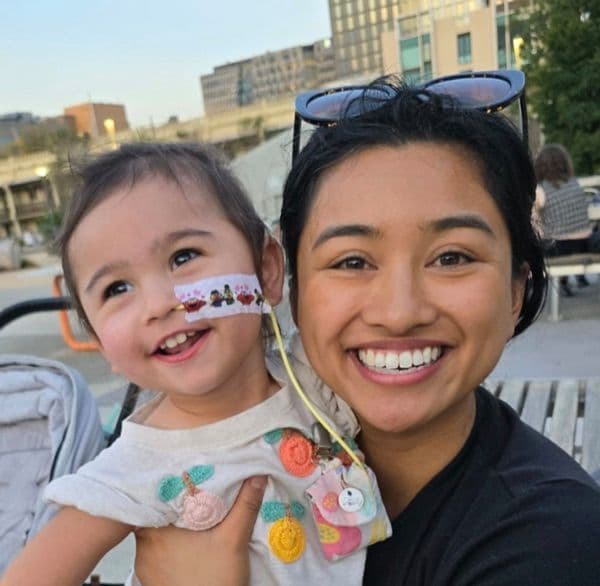
Milanie Gonato is the mother of Stella who has the rare genetic disorder DEE65/CYFIP2.
Watch the talk
5 minutes with… Milanie Gonato
In this deeply moving and inspiring talk, Mil shares her family’s journey—from early concerns during pregnancy to Stella’s diagnosis with a rare genetic condition, and the powerful role of rapid genomic sequencing through the GeneSTEP study.
Through honest reflections and touching stories, Mil highlights the complex challenges faced by families navigating life with rare disease—including epilepsy, developmental delays, feeding difficulties, and hospitalizations. But this is also a story of hope, discovery, and fierce parental advocacy. Mil speaks candidly about what she’s learned from the research, how the CYFIP2 community is growing, and Stella’s incredible progress with therapies.
Topics include:
- Early signs and diagnosis of CYFIP2
- The power of rapid whole genome sequencing
- Living with drug-resistant epilepsy and neutropenia
- Therapeutic approaches and family life
- Future directions: ASOs, drug repurposing, and global collaboration
Watch this video to understand the lived experience behind the science—and the importance of community, research, and relentless love.
Read the transcript
Hi everyone, my name is Mil and I am the very proud mother of this cheeky little girl up the screen named Stella. I’ll tell you a little bit about our family. So it comprises of myself. I am a graphic designer by trade my husband Saxon, and he’s a structural engineer. We have a small business together in structural engineering, and together we have a daughter who is 20 months old and she has a condition called CIP two C-Y-F-I-P two.
And her favorite things to do are watch tv. She’s a catch potato. She loves watching TV with her dad. She for some reason loves Dragon Ball ZI guess it must be all the colors in the animation. She loves kicking us in a playful way. That’s how she communicates. She loves playing with shiny objects like Mardi Gras beads, and she loves hanging out with her cousins and hanging out with her friends at playgroup.
So with Cfic two there are many clinical features of of this condition that Stella has herself. She’s got drug resistant epilepsy intellectual disability. Global developmental delay, hypertonia. So this means that she doesn’t crawl and she doesn’t walk and it’s she’s learning now how to sit independently.
She does have cortical vision in her and as well, which means that she structurally her eyes fine, but the neural pathways are damaged. And so for her, there’s a delay in processing what she sees in front of her. So we have to train her up in, in how to use her vision essentially. She does have feeding her difficulties as well, so she’s got a nasal gastric tube as well.
Micro carefully GERD and neutropenia as well. So currently Stella is now in hospital again, so it’s the eighth time this year since February. And it’s for a common cold, which is nice actually. It’s not for something super, super serious but it just means that she is more prone to infections as well.
So we do have a little bit of a bubble baby. And so leading up to the diagnosis with Stella it was actually quite early within my pregnancy. Doctors recognized that she had fetal growth restrictions, so we were closely monitored. And the main issue that they were concerned about was her head circumference.
It was in the first percentile. And I kept getting questions like, did you go to Brazil? And I’m like, no, what does that mean? And they never said Zika virus, but I googled it. I was like, oh, it’s me. I don’t think I’ve got Zika virus. But when she came out she seemed to have caught up with percentiles and she was in the 50th percentile, and we were just so relieved because the monitoring was quite anxiety inducing I found.
And so she came out and she was just this little cute little chair and we thought, oh, that’s it, that’s the end. Unfortunately, at four weeks she started having some swallowing feeding issues. And so that’s when we presented to hospital and a nasogastric tube was put in place. And we were very gently told that perhaps it might just be a short term thing and then she might grow out of it.
Perhaps she’s got an allergy to cow’s milk protein, and you might just have to figure out your diet. Because at that time she was being breastfed, so I went dairy free and I did all these different things. But as the months went on the pediatrician and maternal child health nurse grew concerned because her head circumference was still quite small.
It just was not catching up and not growing at the expected rate. The pediatrician as well was concerned because she just wasn’t really tracking with her eyes. I knew that she could see light ’cause she was always looking out windows, but I could tell that she also just wasn’t really tracking either.
The pediatrician also noticed that she had hypertonia the feeding issues as well. And then there was Laryn Room Malaysia, which I don’t really know if that’s related to Cfic two. It could just be just something unique to Stella. But there were all these different things which I was hoping to be a coincidence, but it seemed to be indicative of something more.
And then at four and a half months old was when she was diagnosed with imp infantile spasms. We presented to hospital. We were very lucky that we just happened to be living 10 minutes away from the hospital that Ingrid she works at. And we went in and then about two days later, Stella had her first EEG, which confirmed that she had hips arrhythmia.
And so you can see there that there’s some jerking movements. At one point she didn’t have a nasogastric tube in as well, so she was able to feed, but then she regressed again at around the 11, oh, sorry, at the 1314 month is old. And so this is a little bit of a lengthier timeline not lengthy timeline, it’s just very word heavy.
But from what I could see as a parent in 2018 that’s when there were the first reports of Cfic two. And the variant that Stella has is PR 87. It’s one of the more severe phenotypes of this condition. And essentially in 20 19, 20 22, there were more cases that were reported and researchers were finding that specific mutation was causing the more severe features of this condition.
In 2023 a south south Korean researchers began publishing their research on their mouse models of Cfic two. And they were able to I don’t know if create is the right word for it, but they were able to create knockin ice as well. That included the variant that Stella has. And then within this timeline, Stella was diagnosed in 2024, around March or April through the gene step study.
So when Stella presented to hospital with infantile spasms we were then able to enroll into the gene step study. And that study enabled us to get rapid horse genome sequencing. This also meant that Stella was diagnosed within three weeks, which was absolutely phenomenal. It meant that we were able to.
Gain access to supports and link up with certain things like physiotherapy and for international audiences. We’ve got NDIS, which is I can’t remember the national Disability Insurance Scheme. So that means that we get funding for certain things like early childhood intervention, physiotherapy, ot support workers as well.
But yeah, we didn’t really have to wait too long in the grand scheme of things, which I’m absolutely grateful for. It also meant that because we knew what this condition was, I was able to find a Facebook group. It was a very small Facebook group at the time. I think there were about 87 members comprised of carers and parents.
And it was like opening up a Pandora’s box because I could see what the future might hold for Stella. And even though it could, it was very overwhelming. It also meant that it informed my decisions when it came to things like childcare because I came across neutropenia and I thought, what does that mean?
And it meant that with a lower white blood cell count, children with neutropenia more susceptible to infections. And I thought, oh, when it comes to childcare, do I find childcare in the home instead and find someone to just come in and take care of Stella as opposed to sending her out into childcare.
And so I was trying to avoid lots of hospital stays and disruption to, I guess our lives as well. Currently Professor Hun Han in South Korea he’s also indicated through his research as well that the condition can cause cyto architectural changes in the Hippo campus. And so researchers are keen to examine Stella’s brain images as well particularly to look at the hippocampus because that particular spot is essential for things like memory and learning.
And so I don’t really know what these regions mean, but they want to look at specifically ca one and ca three. So the email came in last night and I thought, you know what, I’m just gonna pop this into my slide because Ingrid’s here and Andreas is here as well. And I’m hoping that other clinicians are looking at this as well.
In the future, they may be looking at ASRS as well and drug repurposing. From the reports or the articles that I, I was reading from professor Huns lab he was talking about potentially repurposing drugs such as lithium. But I’m not really sure what any of that sort of means to be honest.
And maybe looking at Assos as well and suppressing the gene at this point in time. Stella is seizure free. So we were able to go into the hospital and under Professor Ingrid’s Ingrid, she’s care we were able to do continuous EEG monitoring and it confirmed that Stella is seizure free currently, but there is still presence of irregular break wave activity.
It’s still a win for us because I’ve noticed that she’s a lot more engaged with her environment. She’s very smiley these days. She’s able to bear weight on her legs. And she’s, yeah, she’s just more communicative and can indicate certain things such as, like she’s got a cold this week, so she was pointing to her chest like my chest hurts, and I went, oh, okay.
So it is, I think really good signs at the moment. And, lots of hospital stays because from what I suspect could be from the neutropenia, but we are going to be seeing a hematologist as well just to see if that is the case. And we may be able to plan certain things or look at different strategies on how to prevent more hospital visits and admissions.
But for instance, like with my husband, he’s still trying to do physiotherapy in the hospital. And she’s very unhappy with it, but it’s we don’t want you losing that skill of, bearing weight on your legs. So she’s very angry. But we have to keep going.
And this is her with all her physiotherapies as well. So now Stella’s able to sit independently but she leans on us or she leans on her hands for support sometimes. She’s able to lean on the couch as well while bearing weight on her legs. She says the word hi and she can briefly hi to people as well.
And she is still training up on, on using her vision and looking at certain things. So she’s able to recognize myself, my husband, her grandparents she can point to us as well, say, oh, here’s mama and who’s dad? And she’ll point and really briefly, not with a finger, in a general direction.
And it’s still very encouraging for us. And so this is her out of hospital after her EEG from March and she’s, trying to bear weight. And this is her doing a bit of vision therapy with a light panel as well. And while on the standup, ’cause I just think it’s really hard doing one type of therapy at a time, so I try and just do it all at the same time because I just don’t have enough time.
So she’s standing and she’s doing vision therapy and so that. That’s it about us and our little family. Thank you.